
Pacific Resource Global editorial team
Short answer: Type I latex allergy is an immediate, antibody (IgE) reaction to proteins in natural rubber latex and can, rarely, be severe. Type IV is a delayed skin reaction, usually to chemicals used in glove manufacturing such as accelerators, not to the latex itself. For buyers, the difference decides which glove material to stock and which documents to ask a supplier for.
This article is general product information for procurement teams. It is not medical advice. Anyone who suspects a glove allergy should consult a doctor or occupational health professional for diagnosis.
Two different reactions, two different causes
Health and safety bodies separate three kinds of skin or body reactions linked to rubber gloves:
| Type I (immediate) | Type IV (delayed) | Irritant contact dermatitis | |
|---|---|---|---|
| Mechanism | IgE antibody response | T-cell (cell-mediated) allergy | Not an allergy |
| Usual trigger | Natural rubber latex proteins | Processing chemicals, e.g. accelerators (thiurams, carbamates) | Sweat, occlusion, frequent washing, chemicals |
| Typical timing | Minutes after contact | Hours later, often peaking at 24–48 hours | Gradual, over days |
| Where it shows | Skin, eyes, nose, airways; rarely systemic | Mainly the skin at the contact site | Dry, red, cracked skin |
Sources: UK HSE, NHS Cambridge University Hospitals, and the American Academy of Family Physicians (links below). The timings are typical patterns reported by these sources, not rules for any individual.
Why the distinction matters when you buy gloves
Type I is about proteins. Because the trigger is natural rubber latex protein, glove choice for a person with confirmed Type I allergy is a clinical and workplace-policy decision, usually moving away from natural rubber latex entirely. NHS guidance warns that some latex gloves sold with allergy-related marketing labels still contain latex, so a label alone is not a substitute for a material decision.
Powder matters for Type I. Glove powder can carry latex proteins into the air. That is one reason many facilities specify powder-free gloves. See our guide to powdered vs powder-free latex gloves.
Type IV is about chemistry. Since delayed reactions are usually linked to processing chemicals rather than latex proteins, switching from latex to nitrile does not automatically remove the trigger: synthetic gloves are also made with chemical additives. A buyer supplying a site with Type IV cases should ask about the chemistry of any glove, latex or nitrile.
What to ask your glove supplier
- Material and powder status: natural rubber latex or nitrile; powder-free or powdered. Our nitrile gloves are not made with natural rubber latex.
- Protein information for latex gloves: European standard EN 455-3 covers biological evaluation including protein. Ask the supplier which test report applies to the exact product and lot. Background: Latex Glove Protein Content and Allergies.
- Chemical information: ask whether the supplier can state the accelerator system used and provide supporting documents. Do not rely on marketing labels.
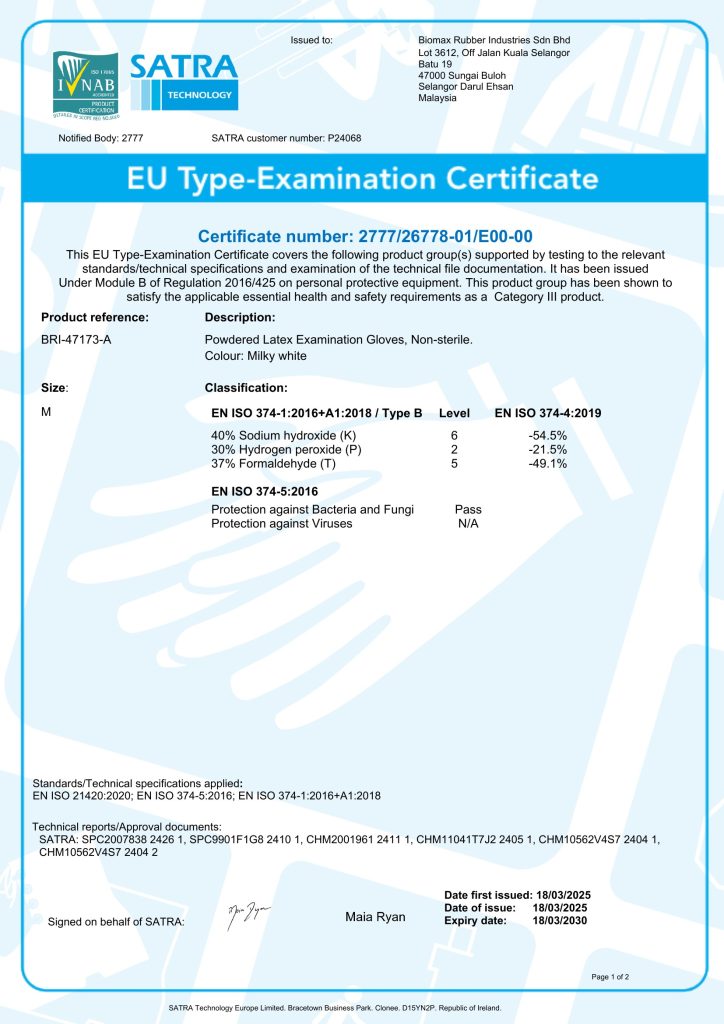
- Quality documents: our latex examination gloves are inspected at AQL 2.5 and nitrile examination gloves at AQL 1.5 for pinholes; our factory holds ISO 13485:2016 quality management system certification, and CE documentation covers product BRI-47173-A. See How to Read Examination Glove Certificates and Spec Sheets.
- Labelling for end users: make sure cartons state the material clearly so staff with a known allergy can avoid the wrong glove.
Latex or nitrile: a procurement view
Latex is still chosen for its fit, elasticity and tactile sensitivity. Nitrile is the usual alternative where natural rubber latex must be avoided. For a side-by-side comparison of specifications, read Latex vs Nitrile Examination Gloves: Which Should You Buy?. Final glove policy for people with a diagnosed allergy should follow medical and occupational health advice.
FAQ
What is the difference between Type I and Type IV latex allergy?
Type I is an immediate IgE reaction to natural rubber latex proteins. Type IV is a delayed skin reaction, usually to manufacturing chemicals such as accelerators.
Does switching to nitrile gloves solve a Type IV reaction?
Not automatically. Type IV reactions are usually linked to processing chemicals, which can also be present in synthetic gloves. A doctor can help identify the trigger.
Do allergy-related labels on latex gloves mean they contain no latex?
No. NHS guidance warns that such labels can appear on gloves that still contain latex. Check the material, not the label.
Why do facilities prefer powder-free gloves?
Powder can carry latex proteins into the air, which raises exposure for people nearby.
Can you tell me which glove is right for my allergy?
No. We can supply product specifications and documents; diagnosis and personal glove advice should come from a doctor.
Need specifications or documents?
Contact us for spec sheets and certificate copies for our latex and nitrile examination gloves.